we have a youtube account. the sign in name is vis70nhermione and password is cremaster
save projects in your name and upload at leisure
Monday, 31 October 2011

THE CREMASTER CYCLE - Matthew Barney
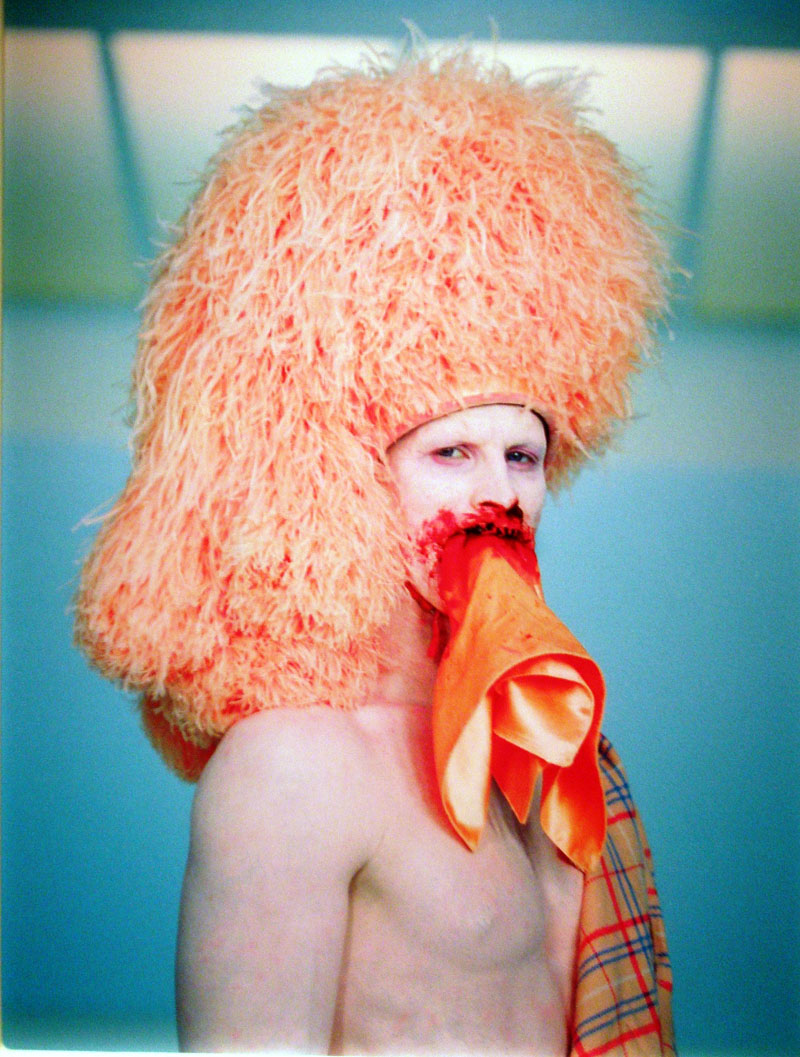 http://www.cremaster.net/
Screened in class:
- Matthew Barney's Cremaster 3 (library has a copy: FVLDV 0839-1)
- No Restraint, documentary film on Matthew Barney and collaboration with Bjork
Library also holds Cremaster Cycle Exhibition Book: N6537.B223 A43 2002
Friday, 28 October 2011
Monday's meetings will be in the FOOD CO-OP by the mandeville center. Tea and tomales.
happy halloween all
http://www.youtube.com/watch?v=XuKjBIBBAL8
happy halloween all
http://www.youtube.com/watch?v=XuKjBIBBAL8
meeting times
Pairings for assignment 2 and discussion appointments:
WEDNESDAY
11:00-11:10 Aaron and Ta
11:00-11:20 Jonathan and Taka
11:20-11:30 hana and yazmine (yu?)
11:30-11:40 Nathan and Ryan (conquerors)
11:40-11:50
MONDAY
10.30-10.40 Daniel, Anthony and Becky
10.40-10.50 Diana and kevin
10:50-11:00 Khanh + Cici
11:00-11:10 tanya & maheen
11:00-11:20 simon chuck
11:20-11:30 Yolanda&Sara
11:30-11:40 kasey & Shine
11:40-11:50 Desiree & Allison
Coffee break – Donna and Sterling
12:00-12:10 Tanner and Ren
12:10-12:20 Josh and Kaylyn
12:20-12:30 Cristina & Julia
12:40- 12.50 Desiree and Allison
12.50- 1:00
Sound Control in PD170 and FCP
Sound control
Manually adjusting volume in PD170
1. if using supplied mic
- change channel select to both channels
- make sure phantom power is set to +48. (there is no need for phantom power with some external mics, if they have a battery supply)
- if camera is using AGC (the auto volume control), you can visulalize volume levels by pressing audio level button, on the bottom left of the camera.
2. MANUAL CONTROL: in PD170 menu, select tape icon, and then audio set drop down menu.
- this allows you to turn AGC (auto gain control) on or off for both channels.
- When using ‘manual gain control’, you will see a sound bar on the lcd screen. -12DB, the ideal volume level, is the mid-point on this bar. Aim to keep frequency around or slightly above this point.
- You will need to turn AGC off in order to manually adjust volume for each imput
- The two mic imput channels may be linked together. You can link and unlink via audio set menu by selecting man gain and then selecting linked or separate.
- You can then select one or both channels and manually adjust using the scroll wheel. To set, press scroll wheel once.
· there is no manual volume control possible on the mini DV cameras. These cameras are always set to auto gain control, and regulate volume for you. There is also only one microphone input, so using an external mic will automatically override the camera’s internal microphone.
Audio in FCP
1. To separate audio from visuals: go to modify menu à unlink
2. To visualize audio frequency on viewer, select arrow icon and show audio waveform from menu.
3. If you cannot see audio temperature bar (this allows you to see sound levels objectively), go window à arrange à standard
4. Hit toggle (mountains) icon to visualize sound line, which you allows you to use pen tool. Use pen tool to create nodes that you can manipulate, in order to fade volume up and down and make sonic transitions.
5. FILTERS
- Use to remove a specific frequency of sound. This can be handy if you have an unwanted background noise of a specific frequency (i.e. air conditioning)
- Highlight piece(s) of audio you want to apply filter to.
- Go to effects menu à audio filters à final cut pro à high pass/ low pass
a) High pass filter takes out lower frequency sounds
b) Low pass filter takes out higher frequency sounds
6. * To cut out undesirable one-off sounds, use splice tool to isolate sound and delete, then fill gap with background audio (n.b this is why it’s really useful to tape several minutes of non-specific, environmental sound).
7. IMPORTING MUSIC
- music files should be in AIFF prior to import to FCP. This is the normal format of tracks on an audio CD.
- To change file type in itunes, right click and select create AIFF version. Then right click, à show in finder, drag/drop into external harddrive, and in FCP under file menu select import à files. (or you can drag/drop AIFF file straight into project).
- …itunes provides the easiest way to convert these files. Use it! Each computer in the media lab also comes with a bank of sound effects in itunes. If you wish to use these, be sure to convert the files to AIFF before inserting into your project.
Wednesday, 26 October 2011
Also at space 4 art that night:
Brianna Rigg

If the Ocean was Whiskey
Contemporary Mythological Objects Inhabit the Space 4 Art
Galleries to Cultivate the Realm of the Fantastic

Exhibition runs October 29 through December 3, 2011

Opening Reception on October 29th, 6-10pm

Space 4 Art Galleries, 325 15th St, San Diego, California 92101


619-269-7230
sdspace4art@gmail.com
www.sdspace4art.org

Monday, 24 October 2011
Dear students
We are getting along well, and I look forward to seeing you rise and shine into media artists of the finest caliber.
Whilst you are attempting and debating the authentic through your films, I am negotiating a method of rewarding you with grades that are likewise 'authentic and true'.
How to mark and objectify 'works of art'? This is muddy terrain.
I want to give you as much agency in this process as possible, like Jean Rouch and the Hauka, lets dance together --
Grades will be weighted towards effort and participation, and conceptual engagement. I urge you to email me with appropriate links, comments, and musings - these will end up on the blog, and you will be accredited accordingly.
Dream reports also welcome.
fondly,
your TA
http://www.youtube.com/watch?v=VjE0Kdfos4Y
We are getting along well, and I look forward to seeing you rise and shine into media artists of the finest caliber.
Whilst you are attempting and debating the authentic through your films, I am negotiating a method of rewarding you with grades that are likewise 'authentic and true'.
How to mark and objectify 'works of art'? This is muddy terrain.
I want to give you as much agency in this process as possible, like Jean Rouch and the Hauka, lets dance together --
Grades will be weighted towards effort and participation, and conceptual engagement. I urge you to email me with appropriate links, comments, and musings - these will end up on the blog, and you will be accredited accordingly.
Dream reports also welcome.
fondly,
your TA
http://www.youtube.com/watch?v=VjE0Kdfos4Y
Anthony's link to the rest of Lars Von Trier's "The Idiots"
I hoped to have time to finish this in today's class. Here it is, courtesy of Anthony
http://www.youtube.com/watch?v=R85D1EF-baM
http://www.youtube.com/watch?v=R85D1EF-baM
Sunday, 23 October 2011
week 5 discussion
from interview with Jean Rouch:
*Rouche began life as an engineer blowing up bridges - was trained by bridge engineer in "resistance to successive stresses" - exercise in material strength and restraint, which he describes as "nothing less than poetry"...
"I apply this double method of sacrilege and of resistance to successive stresses"
[consider 'resistance' and 'stresses' in ref. to Dogma 'vow of chastity' and the construction of rule-sets for your films]
"...that I was, behind the lens of my camera, the first viewer of my film. So if I got bored during filming, the viewers to whom I might show the film would be equally bored. [...] with the camera to my eye, I am what Dziga Vertov called 'the mechanical eye'; my microphone ear is an electronic ear. With a cine-eye and a cine-ear, I am a cine-Rouch in a state of cine-trance in the process of cine-filming."
'Breaking the 4th wall'
http://en.wikipedia.org/wiki/Fourth_wall
interview with Cyprien Gaillard:
http://www.youtube.com/watch?v=qqTGtLZeoCY
Cyprien Galliard's film portfolio:
http://www.bugadacargnel.com/en/pages/artistes.php?name=6564&page=portfolio&categ=4#
Francis Alÿs, "When Faith Moves Mountains" (2002):
http://vimeo.com/14129166
Francis Alys, in interview:
http://www.youtube.com/watch?v=mwmug-DW58M
*Rouche began life as an engineer blowing up bridges - was trained by bridge engineer in "resistance to successive stresses" - exercise in material strength and restraint, which he describes as "nothing less than poetry"...
"I apply this double method of sacrilege and of resistance to successive stresses"
[consider 'resistance' and 'stresses' in ref. to Dogma 'vow of chastity' and the construction of rule-sets for your films]
"...that I was, behind the lens of my camera, the first viewer of my film. So if I got bored during filming, the viewers to whom I might show the film would be equally bored. [...] with the camera to my eye, I am what Dziga Vertov called 'the mechanical eye'; my microphone ear is an electronic ear. With a cine-eye and a cine-ear, I am a cine-Rouch in a state of cine-trance in the process of cine-filming."
'Breaking the 4th wall'
http://en.wikipedia.org/wiki/Fourth_wall
interview with Cyprien Gaillard:
http://www.youtube.com/watch?v=qqTGtLZeoCY
Cyprien Galliard's film portfolio:
http://www.bugadacargnel.com/en/pages/artistes.php?name=6564&page=portfolio&categ=4#
Francis Alÿs, "When Faith Moves Mountains" (2002):
http://vimeo.com/14129166
Francis Alys, in interview:
http://www.youtube.com/watch?v=mwmug-DW58M
Sunday, 16 October 2011
midterm project - Michael's brief
MID TERM VIDEO PROJECT | FALL 2011
------------------------------------------------------------------------------------
------------------------------------------------------------------------------------
1. COLLABORATE WITH ONE (1) OTHER STUDENT
2. MAKE A 2-minute VIDEO
3. THE "SUBJECT" OF THE VIDEO MUST BE A NON-FICTION SUBJECT.
4. PAY ATTENTION TO HOW COMPOSITION and EDITING CREATE AUTHENTICITY IN NON-FICTION WORKS.
DUE: WEEK 6 (11/7) in Discussion Section
week 3 discussion
From reading Rosalind Krauss Video: The Aesthetics of Narcissism (1987) ...
the story of Narcissus: http://en.wikipedia.org/wiki/Narcissus_%28mythology%29]
Qs:
- what features of video define an 'aesthetics of narcissism'?
- how does narcissism arise from and reflect our current cultural condition?
- what are the differences between 'reflectiveness' and 'reflexiveness' (or the 'self-reflective'), in reference to modern art (i.e. Rauschenberg and Jasper Johns) and the video artists mentioned?
- must a 'medium' be material?
Acconci's Centers http://www.youtube.com/watch?v=88DM2nqREtQ
Richard Serra's Boomerang: http://www.youtube.com/watch?v=m5S3_dmj8BU
Joan Jonas' Vertical Roll http://www.youtube.com/watch?v=-oqJZOFzbfA
Jasper Johns' Flag (1930):
http://www.moma.org/collection/object.php?object_id=78805

Guy Maddin, My Winnipeg (netflix): http://movies.netflix.com/WiPlayer?movieid=70081103&trkid=2361637
Lars Von Trier The Idiots (DVD available in library) http://www.imdb.com/title/tt0154421/
Dogme 95 'Vow of Chastity': http://mediebol.stu.cofc.edu/chastity.htm
Werner Herzog - (Screened The Great Ecstasy of Woodcutter Steiner)
IMDB: http://www.imdb.com/name/nm0001348/
...'On the absolute, the sublime and ecstatic truth': http://www.wernerherzog.com/52.html
...Minnesota Declaration (manifesto): http://www.wernerherzog.com/52.html#c93
the story of Narcissus: http://en.wikipedia.org/wiki/Narcissus_%28mythology%29]
Qs:
- what features of video define an 'aesthetics of narcissism'?
- how does narcissism arise from and reflect our current cultural condition?
- what are the differences between 'reflectiveness' and 'reflexiveness' (or the 'self-reflective'), in reference to modern art (i.e. Rauschenberg and Jasper Johns) and the video artists mentioned?
- must a 'medium' be material?
Acconci's Centers http://www.youtube.com/watch?v=88DM2nqREtQ
Richard Serra's Boomerang: http://www.youtube.com/watch?v=m5S3_dmj8BU
Joan Jonas' Vertical Roll http://www.youtube.com/watch?v=-oqJZOFzbfA
Jasper Johns' Flag (1930):
http://www.moma.org/collection/object.php?object_id=78805

Guy Maddin, My Winnipeg (netflix): http://movies.netflix.com/WiPlayer?movieid=70081103&trkid=2361637
Lars Von Trier The Idiots (DVD available in library) http://www.imdb.com/title/tt0154421/
Dogme 95 'Vow of Chastity': http://mediebol.stu.cofc.edu/chastity.htm
Werner Herzog - (Screened The Great Ecstasy of Woodcutter Steiner)
IMDB: http://www.imdb.com/name/nm0001348/
...'On the absolute, the sublime and ecstatic truth': http://www.wernerherzog.com/52.html
...Minnesota Declaration (manifesto): http://www.wernerherzog.com/52.html#c93
Wednesday, 12 October 2011
Editing in Mandeville (from Kate)
Mandeville Center B206 (basement) is the computer lab with Final Cut Pro. The door has a combination lock on the door. In order to enter the computer lab, students must look up their door code BEFORE they go to class.
To find your door code:
1. Go to http://acms.ucsd.edu
2. Click “Account Lookup”. It is on the left hand side under tools.
3. Enter your account name and Student ID.
a. Account name is _______@ucsd.edu
b. Student ID is your PID (A12345678)
4. Scroll to where “Facility” reads B206 and to the right will be “Door Code”. Click the
picture of the arrow pointing towards the door.
a. If not, Click on “View Class Resources”.
b. Enter your regular email password when it prompts you.
THIS IS YOUR PERSONAL CODE.
NOTE: Each student has to look up his/her own code.
If you need help, please go to Mandeville Center 216.
Student may also find out if other computer labs have Final Cut Pro by:
1. Go to http://acms.ucsd.edu
2. Put the cursor over the Students tab to the top and select Computer Labs
3. Select Software Installed on ACMS Computers
4. Search by Software for Final Cut Pro.
To find your door code:
1. Go to http://acms.ucsd.edu
2. Click “Account Lookup”. It is on the left hand side under tools.
3. Enter your account name and Student ID.
a. Account name is _______@ucsd.edu
b. Student ID is your PID (A12345678)
4. Scroll to where “Facility” reads B206 and to the right will be “Door Code”. Click the
picture of the arrow pointing towards the door.
a. If not, Click on “View Class Resources”.
b. Enter your regular email password when it prompts you.
THIS IS YOUR PERSONAL CODE.
NOTE: Each student has to look up his/her own code.
If you need help, please go to Mandeville Center 216.
Student may also find out if other computer labs have Final Cut Pro by:
1. Go to http://acms.ucsd.edu
2. Put the cursor over the Students tab to the top and select Computer Labs
3. Select Software Installed on ACMS Computers
4. Search by Software for Final Cut Pro.
Tuesday, 11 October 2011
Tristan and Isolde (from Desiree)
There are several versions of the myth. But it is known to have
significantly influenced the Lancelot/Guenevere story.

Here is a lovely summary in the form of a song by Irish singer Heather Dale.
http://www.youtube.com/watch?v=EGif9VMEFaA

And alternatively, here is a written account with a slightly different
telling. (A note: Blanchemaine as she is referred in the song, translates
to "White Hands")
http://www.mythencyclopedia.com/Tr-Wa/Tristan-and-Isolde.html
Monday, 10 October 2011
folks. If you get stuck with final cut, there are plentiful tutorials online. search 'final cut pro 7' in youtube and you'll more than likely find what you need. I believe there is also an electronic guide to FCP available through the library. If you have trouble locating this on 'roger' I'm sure the library arts desk can help. Each of your projects (1st assignment) will require a slightly different editing strategy. Don't feel under pressure to perform a multitude of editing techniques just for the sake of it. Form follows function, use what you need.
haiku (via Eisenstein)
http://volweb.utk.edu/school/bedford/harrisms/haiku.htm
"Haiku is a poetic form and a type of poetry from the Japanese culture. Haiku combines form, content, and language in a meaningful, yet compact form. Haiku poets, which you will soon be, write about everyday things. Many themes include nature, feelings, or experiences. Usually they use simple words and grammar. The most common form for Haiku is three short lines. The first line usually contains five (5) syllables, the second line seven (7) syllables, and the third line contains five (5) syllables. Haiku doesn't rhyme. A Haiku must "paint" a mental image in the reader's mind. This is the challenge of Haiku - to put the poem's meaning and imagery in the reader's mind in ONLY 17 syllables over just three (3) lines of poetry! Check out some Haiku at Haiku Salon (see Lesson 2 for the link)."
"Haiku is a poetic form and a type of poetry from the Japanese culture. Haiku combines form, content, and language in a meaningful, yet compact form. Haiku poets, which you will soon be, write about everyday things. Many themes include nature, feelings, or experiences. Usually they use simple words and grammar. The most common form for Haiku is three short lines. The first line usually contains five (5) syllables, the second line seven (7) syllables, and the third line contains five (5) syllables. Haiku doesn't rhyme. A Haiku must "paint" a mental image in the reader's mind. This is the challenge of Haiku - to put the poem's meaning and imagery in the reader's mind in ONLY 17 syllables over just three (3) lines of poetry! Check out some Haiku at Haiku Salon (see Lesson 2 for the link)."
Sunday, 9 October 2011
gallery visits
Three gallery visits are required for this course. Please write a brief
report - half a page to 1 page long - in response to each exhibition you
go to. reflect, celebrate and criticize the work on show, and your
experience there. Basically, convince me you have been, and tell me what
you thought.
more answers to questions
parallel editing: http://www.elementsofcinema.com/editing/parallel_editing.html
art galleries at UCSD:
http://universityartgallery.ucsd.edu/
http://gallery.calit2.net/portal/
...check out this for some goings-ons in wider SD:
http://www.sdcitybeat.com/sandiego/flex-221-2011-fall-arts.html
art galleries at UCSD:
http://universityartgallery.ucsd.edu/
http://gallery.calit2.net/portal/
...check out this for some goings-ons in wider SD:
http://www.sdcitybeat.com/sandiego/flex-221-2011-fall-arts.html
Phyllis Baldino's "unknown series" - interview with the artist
"The Unknown Series (excerpts)"
A bunch of you had questions on this piece last lecture and so I thought I'd share an interview where the artist, Phyllis Baldino (PB), speaks a bit about her process and reasoning behind the piece.
You can read the full interview here: http://www.fringeunderground.com/baldino.html
JMS: There's a sculptural element to this particular work that calls to mind some of your earlier videos, such as "The Gray Series" and "The Unknown Series (excerpts)." Can you talk a little about how sculptural objects figured in those pieces?
PB: My early videos were very much processed-oriented. And the first works I did were literally done in the first take. They were very much about me interacting with particular objects. The objects resulted from the videos. So the objects are sculptural and they exist as an object; the video was a process that created that object. So there are times when I show the video with or without the object, because it doesn't really matter. You can see it separately or you can see it with the object.
"The Gray Area Series" was inspired by Fuzzy Logic. The objects in those videos are what they are-and they are what they are not simultaneously. All of the titles follow the same format: for example, "Silver Screen/Not Silver Screen." It's the question of function. Sometimes I had to destroy an object to make it functional-literally. For example, there was an old cosmetic case I saw in a thrift store on sale for $3. It was locked shut and could not be opened, so they sold it to me for $2. I destroyed it with a jigsaw to make it functional ("Cosmetic/Not Cosmetic"). In another piece ("60's dress/object"), I reconstructed a chair on camera from start to finish. First I chopped it up off camera. I wore a 60's dress that matched the chair and then put it back together just enough so it kind of worked. I mixed up the pieces so I wouldn't know how it was supposed to be put back together. That particular piece has to be shown with its own monitor. That's just the nature of that work. But the other sculptural objects don't need to be seen with their video.
JMS: And "The Unknown Series (excerpts)"?
PB: I kept on finding all these objects that I didn't recognize, like parts of parts of things. So I created unknown personas to fit the unknown concept. I made a rule for myself that each piece had to be under a minute (the excerpt 'is' the piece). What happens before and after is unknown to me, and unknown to you. So you jump into an action and then it's over.

You can read the full interview here: http://www.fringeunderground.com/baldino.html
change of office hour location...
...I've decided 'office hour' will now be held at the food co-op place after class on monday. nice and close to the mandeville. 11.50-12.50pm, come and say hello.
week 2 discussion
Wartime propaganda: positivism and cohesiveness. Single, god-like author. Night Mail by John Grierson (pt1):
http://www.youtube.com/watch?v=-WO7JxYlhOM
Surrealist montage - Un Chien Andalou, by director Buñuel and artist Salvador Dalí:
http://www.zappinternet.com/
// read excerpts from surrealist manifesto //
Social Montage/ plural perspectives
interview about the Mass Observation archives: http://www.youtube.com/watch?v=CEQhy0oFE1w
contemporary Mass Observation: http://www.youtube.com/watch?v=tZFbDY3-eG4&feature=relmfu
Montage and advertising: the film trailer (good films! 'contemporary surrealism', if you like).
inland empire trailer: http://www.youtube.com/watch?v=BBENalLEnSE
gummo trailer: http://www.youtube.com/watch?v=gtY_545-ST8
...and if we have time, the classic 'Man With a Movie Camera' by Diza Vertov
http://www.youtube.com/watch?v=-WO7JxYlhOM
Surrealist montage - Un Chien Andalou, by director Buñuel and artist Salvador Dalí:
http://www.zappinternet.com/
// read excerpts from surrealist manifesto //
Social Montage/ plural perspectives
interview about the Mass Observation archives: http://www.youtube.com/watch?v=CEQhy0oFE1w
contemporary Mass Observation: http://www.youtube.com/watch?v=tZFbDY3-eG4&feature=relmfu
Montage and advertising: the film trailer (good films! 'contemporary surrealism', if you like).
inland empire trailer: http://www.youtube.com/watch?v=BBENalLEnSE
gummo trailer: http://www.youtube.com/watch?v=gtY_545-ST8
...and if we have time, the classic 'Man With a Movie Camera' by Diza Vertov
Monday, 3 October 2011
week 1 discussion
screened in lab:
Gus Van Sant's 'Discipline of Do Easy':
http://www.youtube.com/watch?v=ochyO45Jb0g
media / multiple mediums, various examples
Interactive/ Internet - Aaron Koblin, artist working with Mechanical Turk:
http://www.ted.com/talks/aaron_koblin.html
Interactive/ GPS - Ricardo Dominguez' boarder-crossing GPS devices
(n.b. also an example of news reportage: 'the only continuity [...] an abstract categorial designation (e.g., national) and the recurrent shots of the newsmen, actors who project some well-defined character considered appropriate for this part of the show, such as informed concern, alert aggressiveness, world-weary moralism, or genial confidence.' - David Antin):
http://www.youtube.com/watch?v=uQTwKIpgaU8&feature=related
- Jerome Louis' GPS tree-marking device in the Congo (printed hand-out)...
Sound as medium, installation - Susan Philipsz' 'Lowlands', site-specific sound projection
http://www.youtube.com/watch?v=UWeKzTDi-OA&feature=related
Formal Elements:
Time: Christian Marclay's 'The Clock'
footage/ discussion: http://www.youtube.com/watch?v=rB3CgEnxnYY
news article: http://www.bbc.co.uk/news/world-europe-11692234
Scale: Carl Sagan. Poetic science. The TV science documentary.
http://www.youtube.com/watch?v=VuJ3Tjj40P8&feature=rellist&playnext=1&list=PL720F404A66AB6C14
"My parents were not scientists. They knew almost nothing about science. But in introducing me simultaneously to skepticism and to wonder, they taught me the two uneasily cohabiting modes of thought that are central to the scientific method."
Inside/Outside the frame: Dogtooth, by Giorgos Lanthimos.
- World within a world, edited and constructed worldview Vs shot composition, editing of footage and screenplay. Hermione has the film if you want to see it.
Link to trailer: http://www.imdb.com/video/screenplay/vi2813789721/
Camera use, for reference:
PD170 tutorial:
http://www.youtube.com/watch?v=FVL1LlWDZY0
Gus Van Sant's 'Discipline of Do Easy':
http://www.youtube.com/watch?v=ochyO45Jb0g
media / multiple mediums, various examples
Interactive/ Internet - Aaron Koblin, artist working with Mechanical Turk:
http://www.ted.com/talks/aaron_koblin.html
Interactive/ GPS - Ricardo Dominguez' boarder-crossing GPS devices
(n.b. also an example of news reportage: 'the only continuity [...] an abstract categorial designation (e.g., national) and the recurrent shots of the newsmen, actors who project some well-defined character considered appropriate for this part of the show, such as informed concern, alert aggressiveness, world-weary moralism, or genial confidence.' - David Antin):
http://www.youtube.com/watch?v=uQTwKIpgaU8&feature=related
- Jerome Louis' GPS tree-marking device in the Congo (printed hand-out)...
Sound as medium, installation - Susan Philipsz' 'Lowlands', site-specific sound projection
http://www.youtube.com/watch?v=UWeKzTDi-OA&feature=related
Formal Elements:
Time: Christian Marclay's 'The Clock'
footage/ discussion: http://www.youtube.com/watch?v=rB3CgEnxnYY
news article: http://www.bbc.co.uk/news/world-europe-11692234
Scale: Carl Sagan. Poetic science. The TV science documentary.
http://www.youtube.com/watch?v=VuJ3Tjj40P8&feature=rellist&playnext=1&list=PL720F404A66AB6C14
"My parents were not scientists. They knew almost nothing about science. But in introducing me simultaneously to skepticism and to wonder, they taught me the two uneasily cohabiting modes of thought that are central to the scientific method."
Inside/Outside the frame: Dogtooth, by Giorgos Lanthimos.
- World within a world, edited and constructed worldview Vs shot composition, editing of footage and screenplay. Hermione has the film if you want to see it.
Link to trailer: http://www.imdb.com/video/screenplay/vi2813789721/
Camera use, for reference:
PD170 tutorial:
http://www.youtube.com/watch?v=FVL1LlWDZY0
Subscribe to:
Posts (Atom)